Pakistan Iran military aircraft conflict: 3 shocking revelations from the CBS News report

Pakistan Iran military aircraft conflict has taken a dramatic turn following an exclusive investigative report by CBS News. Highly classified intelligence leaks allege that Islamabad quietly permitted Iranian military assets to park on its strategic airfields, setting off an intense international diplomatic crisis. The explosive revelations surface at a deeply sensitive time, given that Pakistan has been actively presenting itself as a neutral, objective mediator trying to defuse the high-stakes confrontation between Washington and Tehran.
As official statements from global superpowers clash, the developing situation highlights the fragile tightrope that South Asian nations must walk when dealing with Middle Eastern geopolitical rivalries. Analyzing the specific intelligence claims, the official denials, and the split reactions from Washington reveals the profound depth of this unfolding international incident.
The CBS News Leak: What Happened at Nur Khan Airbase?
The controversy erupted when a detailed report by CBS News cited high-level United States national security officials who claimed that Pakistan had compromised its neutral status. According to the intelligence leak, Islamabad allowed Iranian military aircraft to cross its borders and station themselves at a major military installation shortly after a regional ceasefire was declared in early April 2026.
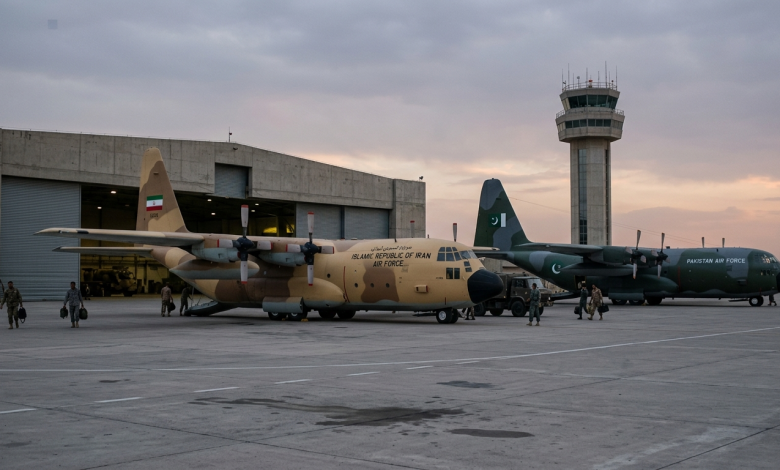
The report specifically pointed to Pakistan Air Force Base Nur Khan, a highly secure facility located near Rawalpindi. Intelligence analysts tracked multiple foreign assets at the site, most notably an Iranian Air Force RC-130—a specialized, high-value reconnaissance and intelligence-gathering aircraft.
U.S. officials suggested that this movement was a calculated tactical maneuver by Tehran. By moving its sensitive aviation infrastructure onto Pakistani soil, Iran sought to create a strategic shield, protecting its remaining aerial intelligence assets from potential American precision strikes by placing them inside the sovereign airspace of a neutral country.
Islamabad Stiffens Defenses: The Logistical Explanation
Faced with a brewing diplomatic storm, Pakistan’s Ministry of Foreign Affairs responded swiftly and decisively to counter the espionage narrative. Government representatives explicitly rejected the military shielding accusations, formally labeling the CBS News report as “misleading and sensationalised.”
The official defense presented by Islamabad outlines a very different operational reality:
- The Islamabad Talks: Pakistan has been serving as the physical host for critical, indirect peace negotiations between the conflicting parties, requiring continuous regional flight access.
- Dual Delegation Logistics: Transport aircraft from both the United States and Iran had landed at the base following the ceasefire to transport essential peace negotiators, security personnel, and administrative teams.
- The Urban Center Reality: High-ranking Pakistani officials noted that Nur Khan Air Base is situated directly within a densely populated metropolitan area, making any clandestine attempt to conceal a secret foreign military fleet logistically impossible.
According to the state perspective, routine administrative and logistical support is mandatory for any nation hosting international peace summits. Conflating standard diplomatic transport with active military alignment, they argued, completely mischaracterizes a transparent peace process.
The Evidence Dilemma: High-Resolution Satellite Imagery
The diplomatic defense faced immediate complications when defense analysts and independent researchers began examining commercial satellite data. Despite the absolute denials from Islamabad’s foreign ministry, subsequent high-resolution satellite imagery dated April 25, 2026, began circulating globally.
The visual evidence revealed a distinct, desert-camouflaged Iranian C-130 transport aircraft parked openly on the tarmac near a main maintenance hangar at the base. The unique, multi-tone desert camouflage pattern stood out sharply against the standard, uniform gray C-130 transport aircraft traditionally operated by the Pakistan Air Force, creating a significant public relations challenge for the mediating government.
Washington’s Split Reaction: Graham vs. Trump
The CBS News revelations triggered immediate, conflicting reactions within the upper echelons of United States political leadership, exposing a clear divide in how Washington intends to handle its South Asian ally.
Congressional Backlash
On Capitol Hill, prominent lawmakers expressed intense skepticism regarding Pakistan’s actual neutrality. U.S. Senator Lindsey Graham led the critics, publicly calling for a “complete reevaluation” of the bilateral strategic relationship and questioning Pakistan’s role as a mediator. Critics argued that providing physical harbor to foreign military hardware during an active dispute inherently compromises a broker’s objectivity.
Presidential Endorsement
In stark contrast to congressional fury, U.S. President Donald Trump took a highly conciliatory approach to the crisis. Dismissing the mounting demands to find a new, alternative mediator, the President publicly praised Pakistani Prime Minister Shehbaz Sharif and Army Chief Field Marshal Asim Munir. Trump described their leadership and handling of the fragile peace process as “absolutely great,” prioritizing long-term regional stability and open communication corridors over the airfield dispute.
Frequently Asked Questions On The CBS News Intelligence Leak
Why is the Pakistan Iran military aircraft conflict causing a diplomatic crisis?
The crisis stems from a CBS News report alleging that Pakistan allowed Iranian military planes, including an RC-130 reconnaissance aircraft, to park at a Pakistani airbase, raising questions about Pakistan’s neutrality as a mediator.
Did satellite imagery confirm the Pakistan Iran military aircraft conflict details?
Yes, high-resolution satellite imagery dated April 25, 2026, captured a desert-camouflaged Iranian C-130 parked near a hangar at Pakistan Air Force Base Nur Khan, contrasting with Pakistan’s gray aircraft.
How has the U.S. government responded to the airfield allegations?
The response is split. While congressional leaders like Senator Lindsey Graham want a complete reevaluation of the relationship, President Donald Trump has praised Pakistan’s leadership and supports their ongoing mediator role.
Balancing Sovereignty and Global Mediations
The intersection of territorial sovereignty, wartime logistics, and international mediation remains incredibly volatile. While satellite imagery and intelligence leaks continue to fuel intense security debates, the underlying reality highlights the extreme difficulty of serving as a peace broker between bitter adversaries. Managing international transparency while providing the necessary transport logistics for peace talks requires flawless diplomatic precision.
Discover more comprehensive geopolitical analyses and defense updates by exploring our dedicated regional security briefings. Stay informed on critical global developments by subscribing to our international relations newsletter today.