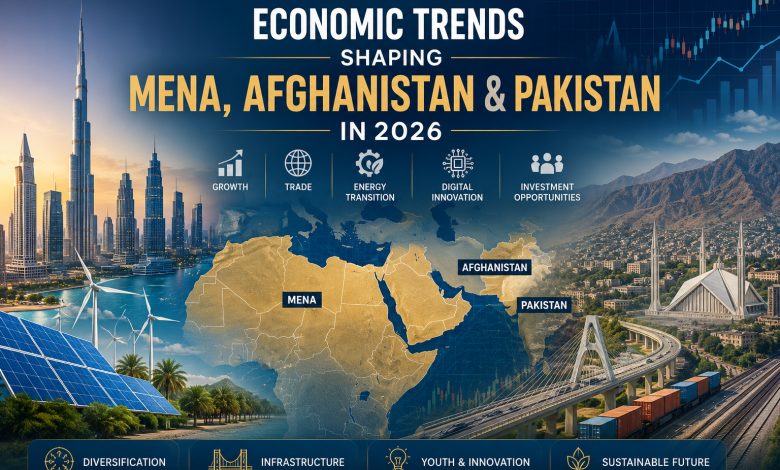
The economic landscape of the Middle East, North Africa (MENA), Afghanistan, and Pakistan is experiencing major transformation in 2026. Global economic uncertainty, technological innovation, energy market fluctuations, and geopolitical developments are influencing how countries across the region plan their economic future. Governments are increasingly focusing on diversification, infrastructure investment, digital transformation, and regional cooperation to strengthen economic stability and long-term growth.
For many Middle Eastern countries, oil and gas continue to play a central role in national economies. However, 2026 has shown a stronger push toward reducing dependence on traditional energy revenues. Nations such as Saudi Arabia, the United Arab Emirates, and Qatar are investing heavily in tourism, renewable energy, smart cities, artificial intelligence, and financial technology. Large-scale projects and development programs are attracting international investors and creating new employment opportunities for local populations. The growth of non-oil sectors is becoming one of the most important economic priorities across the Gulf region.
The renewable energy sector is also expanding rapidly throughout MENA. Solar and wind energy projects are gaining momentum as governments attempt to meet sustainability goals and prepare for a future less dependent on fossil fuels. Countries with strong sunlight exposure and large desert areas are turning renewable energy into a strategic advantage. International companies are partnering with regional governments to develop energy infrastructure, modernize power grids, and increase clean energy production capacity.
Technology and digital transformation are becoming key drivers of economic growth in 2026. Across the region, businesses are adopting artificial intelligence, cloud computing, e-commerce platforms, and digital payment systems to improve efficiency and compete globally. Startups are growing quickly, particularly in sectors such as fintech, logistics, health technology, and online education. Governments are also investing in digital infrastructure to support innovation and attract foreign technology companies. Young entrepreneurs and skilled freelancers are playing an increasingly important role in shaping the digital economy.
Trade and logistics remain critical to the economic development of the region. Strategic geographic locations allow MENA countries to act as major global trade hubs connecting Asia, Europe, and Africa. Ports, shipping routes, rail networks, and transportation corridors are being upgraded to increase efficiency and support international trade growth. Regional partnerships and economic agreements are helping improve cross-border commerce and strengthen economic integration between neighboring countries.
Inflation and cost-of-living challenges continue to affect many economies across the region. Rising food prices, currency fluctuations, and global supply chain disruptions have created pressure on both businesses and consumers. Governments are responding through subsidies, monetary policy adjustments, and economic reforms aimed at controlling inflation while maintaining growth. Central banks across several countries are closely monitoring interest rates and financial stability to manage economic risks effectively.
The tourism sector has become one of the fastest-growing industries in many Middle Eastern and North African countries. Major investments in entertainment, hospitality, cultural events, and international tourism campaigns are helping diversify revenue streams. Cities across the Gulf region are hosting global conferences, sports tournaments, technology exhibitions, and cultural festivals to attract millions of international visitors each year. Tourism growth is also creating opportunities for small businesses, restaurants, hotels, transportation services, and local entrepreneurs.
North African economies are also undergoing significant economic changes in 2026. Countries such as Egypt, Morocco, and Algeria are focusing on infrastructure modernization, industrial growth, and renewable energy development. Agriculture remains an important sector for employment and exports, but governments are increasingly prioritizing industrialization and foreign investment to strengthen economic resilience. Manufacturing, automotive production, and technology outsourcing services are expanding in several North African countries as international companies seek cost-effective regional markets.
Pakistan’s economy in 2026 continues to face both challenges and opportunities. Inflation, currency pressure, and fiscal management remain major concerns, but there are signs of gradual recovery in several sectors. Information technology exports, freelancing, e-commerce, and digital banking are growing rapidly, especially among younger populations. Pakistan’s startup ecosystem has expanded considerably, with increasing investment in fintech, education technology, and online services.
Infrastructure development remains a key part of Pakistan’s economic strategy. Projects related to transportation, energy production, and urban development are helping improve connectivity and business activity. Trade relations with regional partners, including China and Gulf countries, continue to influence economic growth and investment opportunities. The government is also encouraging foreign investment through policy reforms and initiatives aimed at supporting businesses and industrial expansion.
Agriculture continues to play a major role in Pakistan’s economy, employing millions of people and contributing significantly to exports. However, climate change, water shortages, and rising production costs are creating long-term challenges for the agricultural sector. Modern farming techniques, improved irrigation systems, and agricultural technology investments are becoming increasingly important for future sustainability and food security.
Afghanistan’s economy remains in a difficult transition period in 2026. Political uncertainty, limited international financial support, and humanitarian challenges continue to impact economic development. Despite these difficulties, local trade networks, small businesses, and regional commerce are helping sustain parts of the economy. Cross-border trade with neighboring countries remains important for economic activity and employment generation.
Human capital and education are becoming more important across the entire region. Governments are investing in skills development, digital education, vocational training, and entrepreneurship programs to prepare younger generations for future labor markets. Remote work opportunities and the global freelance economy are also creating new income sources for skilled professionals in Pakistan, North Africa, and parts of the Middle East.
The banking and financial services sector is evolving rapidly throughout the region. Digital wallets, mobile banking applications, cryptocurrency discussions, and fintech innovation are reshaping how consumers and businesses manage financial transactions. Financial inclusion is improving as more people gain access to online banking and digital payment solutions, especially in developing economies where traditional banking access was previously limited.
Foreign direct investment remains a major focus for regional governments. Countries are competing to attract international investors through business-friendly policies, tax incentives, special economic zones, and infrastructure improvements. Stable political environments, advanced digital infrastructure, and economic reforms are becoming critical factors in attracting long-term foreign investment.
Geopolitical developments continue to influence economic stability across the region. Energy markets, trade agreements, diplomatic relations, and global economic policies all impact growth forecasts for MENA, Afghanistan, and Pakistan. Governments are increasingly focusing on regional cooperation and economic partnerships to reduce economic risks and strengthen long-term resilience.
Looking ahead, the economic future of the region will largely depend on diversification, innovation, political stability, and the ability to adapt to global economic changes. Countries that successfully invest in technology, education, renewable energy, and private sector growth are likely to experience stronger economic performance in the coming years. Despite existing challenges, the region holds significant potential due to its young population, strategic geographic position, natural resources, and expanding digital economy.
In 2026, MENA, Afghanistan, and Pakistan are collectively moving through a period of economic transformation that could redefine regional growth for the next decade. Businesses, investors, entrepreneurs, and policymakers are all adapting to a rapidly changing global economy where innovation, sustainability, and digital connectivity are becoming essential drivers of success.