African private sector investment: 3 massive ways Dangote is unlocking a $2 trillion wealth fund

African private sector investment has ignited a massive paradigm shift in the global financial ecosystem. A historic high-level meeting in the industrial sector has demonstrated that domestic resource mobilization is the single most powerful catalyst for attracting international capital. The breakthrough surfaces at a crucial moment for the continent, proving that when local leaders heavily commit to their own markets, global institutional powerhouses quickly follow suit.
As domestic strategies and international funding align, the developing economic landscape highlights the immense potential of building regional corporate infrastructure. Evaluating the specifics of this multi-trillion-dollar engagement, the targeted industrial sectors, and the global corporate leaders involved reveals how local initiatives are completely redefining international development partnerships.
The Power of Local Capital: Mobilizing the African Private Sector
The foundation of sustainable economic growth relies on a robust domestic foundation. Financial experts have long argued that relying on external aid is insufficient; instead, fueling a strong African private sector investment strategy is the true driver of real economic development. By building competitive local industries, African nations are proving they can mitigate risks and present highly lucrative, mature options to foreign asset managers.
This strategy acts as a powerful signal to the global market. When international financiers witness local conglomerates pouring billions into infrastructure, agriculture, and manufacturing, it builds immense commercial confidence. The resulting momentum accelerates co-investment opportunities, transforming the continent from a perceived high-risk zone into an indispensable frontier for global industrial growth.
The Three-Way Alliance: Dangote, Norway, and Global Industrial Giants
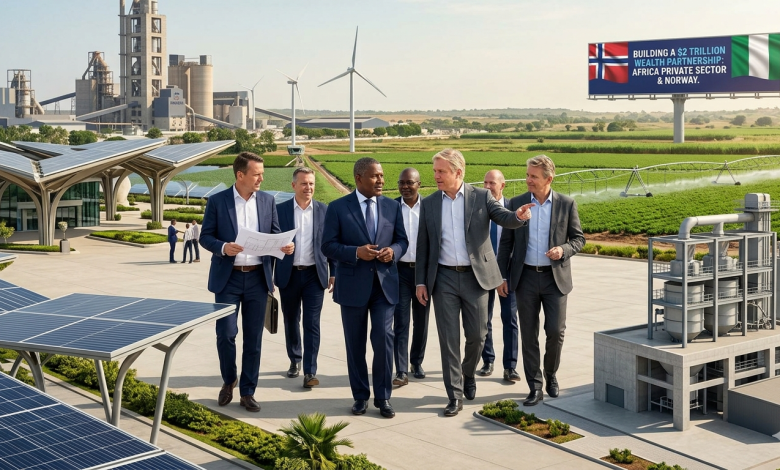
The commercial reality of this investment pattern was recently put on full display during a monumental strategic meeting hosted by Africa’s richest man, Aliko Dangote. The high-stakes talks signaled a massive deepening of international interest in the region’s industrial future.
The meeting brought together a powerful trio of economic forces:
- The Two-Trillion-Dollar Fund: Nicolai Tangen, head of Norges Bank Investment Management—which oversees Norway’s staggering $2 trillion sovereign wealth fund—participated to explore massive institutional partnerships.
- Agricultural Tech Leadership: Svein Tore Holsether, Chief Executive Officer of Yara International, joined the talks to align global fertilizer and agricultural supply chain expertise with local networks.
- Renewable Energy Infrastructure: Terje Pilskog, Chief Executive Officer of Scatec ASA, brought international clean energy development capabilities to the table, targeting sustainable long-term power projects.
This unprecedented alignment of domestic execution capability and massive Western capital directly validates the theory that local corporate strength acts as the ultimate anchor for global partnerships.
High-Growth Sectors Eyed for Deep Expansion
According to official statements from Dangote Industries Limited, the Norwegian investment institution and its partners are looking to scale up operations across multiple critical sectors. Rather than focusing on speculative markets, the capital is targeting core industrial pillars designed to foster long-term structural stability.
The primary sectors targeted for joint expansion include:
- Energy and Renewables: Building robust power grids and deploying scalable renewable energy infrastructure to fuel growing industrial zones.
- Agriculture and Fertilizer: Expanding high-yield agricultural inputs and sustainable farming solutions to secure regional food supplies.
- Heavy Manufacturing: Scaling up cement production and essential construction materials to support the continent’s rapid urban and commercial development.
By investing heavily in these foundational areas, the partnership ensures that the incoming capital creates a tangible, lasting economic multiplier effect across the entire region.
Frequently Asked Questions On Global Industrial Alliances
Why is African private sector investment critical for attracting global funds?
Local investment builds market confidence, establishes necessary corporate infrastructure, and lowers perceived risks, making the continent highly attractive to massive institutional asset managers.
Which major global funds are entering partnerships with the Dangote Group?
Norges Bank Investment Management, which manages Norway’s $2 trillion sovereign wealth fund, has expressed strong interest in expanding industrial and energy partnerships alongside leaders like Yara International and Scatec ASA.
What industries will benefit most from this new wave of co-investment?
The capital is strictly targeted toward core structural sectors, specifically power and renewable energy, agriculture, fertilizer production, and heavy cement manufacturing.
A New Era of Catalytic Global Partnerships
The intersection of domestic resource mobilization and international institutional capital marks a turning point for global economics. While foreign aid models are fading, a business-first approach driven by a powerhouse African private sector investment strategy is proving to be the ultimate catalyst for real economic development. Establishing strong, transparent corporate partnerships is paving the way for unprecedented industrial expansion.
Discover more comprehensive economic analyses and trade updates by exploring our dedicated regional growth briefings. Stay informed on critical global developments by subscribing to our international finance newsletter today.